
Showing posts with label science. Show all posts
Showing posts with label science. Show all posts
Friday, 5 July 2019
Embrace Every Drop of Water
Water is a very important resource that was once available in abundance but now becomes less accessible. Pollution renders water useless. Embrace water now! Stop the pollution!


Tuesday, 14 November 2017
Warning from Our Own
You know you’re screwed if the warning is coming from one of your own.
Largest Ever Group of Scientists Issues Humanity an Urgent Warning: Time Is Running Out

Largest Ever Group of Scientists Issues Humanity an Urgent Warning: Time Is Running Out

Sunday, 22 January 2017
Genetically modified apples won't turn brown after slicing
The beauty of genetic engineering. The unattractive brownish oxidised stuff that you see in apples moments after cutting them is a thing of the past.
via Engadget.

via Engadget.

Thursday, 19 January 2017
2016 Marks Record Rising Temperature 3 Years in a Row
Uh oh...
Average surface temperatures over land and the oceans in 2016 were 0.94 degrees Celsius (1.69 degrees Fahrenheit) above the 20th-century average of 13.9C (57.0F), according to the U.S. National Oceanic and Atmospheric Administration (NOAA).But there's hope...
At a conference in Paris in late 2015, governments agreed a plan to phase out fossil fuels this century and shift to renewable energies such as wind and solar power.
They agreed to limit warming to "well below" 2 degrees Celsius (3.6F) above pre-industrial times, while pursuing efforts for 1.5C (2.7F). By that yardstick, the rise stood at about 1.1C (2.0F) in 2016.via Reuters.
Monday, 30 May 2016
The Superbug Evolution
Based on what I understand from two articles that I read on the same day (one from Reuters and the other via Forbes), the American superbug has evolved and is now resistant to antibiotics while another superbug - this one created - will consume hydrogen and carbon dioxide to produce fuel.
One deadly and the other beneficial. I have faith humans will overcome the deadly bug soon.
One deadly and the other beneficial. I have faith humans will overcome the deadly bug soon.
Friday, 4 March 2016
Advances in Space Travels
Space, the final frontier, they say. For all we know (barring all those governmental conspiracies) there had not been anyway for humans to go that far but there had always been theories. Some of these theories are starting to materialise and look promising:
1. Photonic Propulsion
With a large, reflective sail, it would be "possible to generate enough momentum to accelerate a spacecraft" via lasers pulsing light from the surface of the Earth.Just 3 days to Mars and another 3 days back. Wow.
2. Antimatter Rockets
Another cool theory would be using antimatter rockets with energy created when positrons and electrons come into contact to power spacecrafts. Speed can go up to 72 million miles per hour.
via WIRED.co.uk
Sunday, 24 January 2016
Water - the other factor that could change how your cup of coffee tastes
The other factor that stands in the way of your perfect cup of coffee - water! The beans can be the same but depending where and when you brew, the taste might just differ.
via Tech Insider.
Some of the compounds in hard water are "sticky," glomming onto certain compounds in coffee when they meet in your coffee-making device. The more eugenol the water hangs on to, for example, the woodsier the taste of your coffee will be.Meanwhile, if you use soft water - the distilled type - the coffee would always taste the same. So for a consistent brew, you know what to do.
via Tech Insider.
Saturday, 28 November 2015
Sunday, 22 November 2015
Cyborg Plants
If you think the Terminator days are still far away or even just pure fiction, think again. It's all happening, just that not the way depicted in the movies...
via Gizmodo.
first, the the researchers introduce a synthetic polymer called PEDOT-S into the rose through its stem. The plant sucks up the polymer using the same vascular system (xylem) that transports water. Once inside xylem channels, the polymer self-assembles into an “wire” that conducts electrical signals, while still allowing water and nutrients to move around. By connecting these wires with naturally-occurring electrolytes in the plant’s tissue, the researchers are able to create an electrochemical transistor, as well as a digital logic gate, a basic component of computer systems.Every story has a beginning...
via Gizmodo.
Sunday, 20 September 2015
Call it corn or maize as you wish but do you know if it's a veggie or a fruit? Hah!
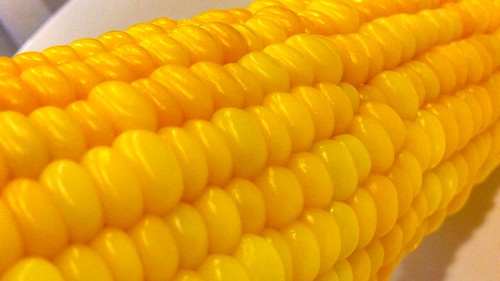
Whatever you choose to call it, corn is never my favourite but what interest me today was is it a fruit or a vegetable? The first search result from old faithful Google came up with that it's actually both a vegetable and a fruit and can be categorised in the grain category, even:
Corn seed is actually a vegetable, a grain, and a fruit. Corn seed is a vegetable because it is harvested for eating. (Usually sweet corn when grain is harvested at the milk stage.) Corn seed is a grain because it is a dry seed of a grass species. (Usually field corn when harvested after the grain is relatively dry.) Corn seed is a fruit because that is the botanical definition. More details follow. Corn (Zea mays) is sometimes called a vegetable grain. Corn is a monocotyledon with only one seed leaf like grasses. The easily identified "grains" (or cereal plants/grasses) such as wheat, oats, and barley are also monocots. A grain is defined as the harvested dry seeds or fruit of a cereal grass, or the term can refer to the cereal grasses collectively. Field corn that is harvested when the seeds are dry would thus be considered a grain. Sweet corn when harvested before maturity is usually considered a vegetable. It is grown to be eaten fresh as a tender vegetable rather than as a dried grain suitable for grinding into flour or meal. A vegetable is defined as a plant cultivated for an edible part or parts such as roots, stems, leaves, flowers, or seeds/fruit. If you want to be very precise, all cereal grains could be called vegetables, but by convention we separate the cereal grains from the rest of the "vegetables" such as peas, lettuce, potatoes, cabbage, etc.
Tuesday, 23 June 2015
Thursday, 14 May 2015
Imperfect leaves or is life's like that - there will always be spots here and there?
Everyday I pass by these plants I wonder what's with the spots on the leaves. Cellulose? Maybe not. I don't know. I've forgotten and swept my science lessons under the bed a long time ago. Any help?
Saturday, 9 May 2015
A Hibiscus and its Reproductive Organs
Here you go, a macro shot of the hibiscus' reproductive organ where both male and female parts are. It's not easy to focus this close with the iPhone. Took me lots of attempts. Wonder if the iPhone 6 (Plus) are any better.
Sunday, 5 April 2015
Fractals and Mandelbrot
This is, obviously, a photo taken under a tree but somehow, it reminds me of Fractals and Mandelbrot sets. These are complex mathematical stuff that go on and one. I got to know about these during my Atari ST days. It was hot stuff during that time. People were writing software to generate them.
Monday, 16 March 2015
Why do crackers (and some biscuits) have holes?
Because of this curious question that kept spinning in my mind today, I Googled and found a site called Today I Found Out which gave the answer to this and many more everyday questions that we easily brush off as trivia. I'm impressed with the site and added it to my Feedly RSS feeds.
So, I gather that the holes in biscuits are decorative while the holes in crackers are there for a reason(s) as explained by Today I Found Out:
So, I gather that the holes in biscuits are decorative while the holes in crackers are there for a reason(s) as explained by Today I Found Out:
In actuality, without these holes, crackers wouldn’t bake correctly. These holes allow steam to escape during cooking. This keeps the crackers flat, instead of rising a bit like a normal biscuit as the steam tries to escape; these holes also help to properly crisp the crackers.
Sunday, 24 August 2014
Transparent Solar Panels

"We can tune these materials to pick up just the ultraviolet and the near infrared wavelengths that then ‘glow’ at another wavelength in the infrared. Because the materials do not absorb or emit light in the invisible spectrum, they look exceptionally transparent to the human eye."
Once absorbed, the light waves get trapped and guided to the edges of the plastic solar concentrator where photovoltaic cells turn them into electricity.However, with anything new, it would take time for improvement. This particular type of solar panel currently only has 1% efficiency compared to the conventional 25%.
via Inhabitat.
Thursday, 24 July 2014
In the face of Apple's iWatch rumours and bonsai in space, there's the worrying thing if Mac Mini will still exist...
I'm a fan of the Mac Mini even though after years of ranting I've still not own one (shame!). So, it's getting worrying by the day as more new iWatch rumours appear and even with a bonsai travelling to space, there's still no news of a Mac Mini... not even a refresh. :'(
 comics via Macworld.

Monday, 12 May 2014
Self-Healing Plastic
New tech galore, this plastic heals just like us:
via Engadget.
Unlike ordinary plastics, this one contains a thin network of tubes, aping the human vascular system, containing two separate gels that react when they come into contact with each other. When the surface of the plastic is punctured, for instance if shot by a bullet, the two gels pour out, mixing to form a surface roughly 60 percent as strong as the original -- just like a blood clot would on our bodies.Wow.
via Engadget.
Thursday, 24 April 2014
Dirty Money, Literally
Money is dirty indeed.
via npr.
Each dollar bill carries about 3,000 types of bacteria on its surface, scientists have found. Most are harmless. But cash also has DNA from drug-resistant microbes. And your wad of dough may even have a smudge of anthrax and diphtheria.While the study did offer some form of assurance, it makes mobile payment look like an ingenious idea, huh?
via npr.
Sunday, 20 April 2014
The secret behind how those washing detergents "brighten" clothes and why LEDs will deter that effect
Couldn't make a shorter subject title without saying less. :/
Finally, I've been enlightened (via Gizmodo) on how some washing detergents actually do brighten clothes. Used to think this was just advertising gimmick but there is some truth to it. Detergents contain fluorescent whitening agents (FWAs) that absorb ultraviolet light and then re-emit it as a bluish tone which make old, yellowish clothes look bright and radiant again.
But this trick will not work when these FWAs are exposed to LED light source because LED emit very little to no UV light. Gasp!
There is a solution, though, and these come in the form of non-standard tuned LEDs that emulate halogen bulbs by emitting certain violet rays. Guess detergent companies would need to cut deals with LED manufacturers, huh?
via Gizmodo.
Finally, I've been enlightened (via Gizmodo) on how some washing detergents actually do brighten clothes. Used to think this was just advertising gimmick but there is some truth to it. Detergents contain fluorescent whitening agents (FWAs) that absorb ultraviolet light and then re-emit it as a bluish tone which make old, yellowish clothes look bright and radiant again.
But this trick will not work when these FWAs are exposed to LED light source because LED emit very little to no UV light. Gasp!
There is a solution, though, and these come in the form of non-standard tuned LEDs that emulate halogen bulbs by emitting certain violet rays. Guess detergent companies would need to cut deals with LED manufacturers, huh?
via Gizmodo.
Subscribe to:
Posts (Atom)